


 Create Account
Prologue
People love a good story.
Narratives help us make sense of complex ideas, whether it’s an epic fantasy tale or intimate, human drama. Handled well, the right story can teach, uplift, and inspire to action.
Advertisers share the same goal; we’re storytellers, crafting a narrative to help consumers understand the brand as a whole. In the task of digital storytelling, there’s no greater tool than the full suite of programmatic channels.
This week, Genius Monkey is taking a look at how omnichannel programmatic can form the backbone of your marketing strategy. Let’s dive into how to create a brand narrative, and how the Genius Monkey platform can be used to best tell your story.
Chapter 1: Why Storytelling Matters in Advertising
The ultimate goal of good advertising is connection. A discount or limited-time offer might prompt a quick purchase, but emotional connections are what keep customers coming back. Brands that resonate on a deeper level are the ones consumers remember, trust, and advocate for.
Think of a single ad as one chapter in a much larger story. On its own, it may spark interest, but lasting connections are developed over time. That requires multiple touchpoints, delivered consistently and strategically. This is a task programmatic advertising is uniquely built for.
With omnichannel programmatic, your story doesn’t live in just one place. It follows your audience as they browse websites, stream video, listen to podcasts, or watch TV at home. Each interaction reinforces the narrative, building familiarity and trust. By being present across devices and platforms, your message reaches consumers wherever they are, allowing the story to unfold naturally over time.


Chapter 2: Know Your Audience Before Writing the Story
Every great author knows their reader before they write a single word. The same principle applies to brand storytelling. Without a clear picture of who you’re speaking to, even the most compelling narrative falls flat.
Demographics are a starting point, but effective targeting goes deeper than age and location. What are your consumers’ interests? What problems are they trying to solve? Where do they spend their time online, and what kind of content actually holds their attention?
Think of it this way: you wouldn’t tell the same story the same way to a room full of retirees and a room full of college students. Knowing your audience lets you tailor the narrative without losing its core identity. The story stays the same; the telling adapts.


Chapter 3: Crafting a Brand Narrative
You also need to know what story you’re telling. A strong brand narrative is the culmination of several core elements:
- History: Where did your company come from? What experiences or challenges shaped its values?
- Mission: What singular experience or impact does your brand aim to deliver?
- Values: The ethical principles your brand stands on. These inform how you operate and communicate.
- Goals and Policy: The tangible actions, rules, and commitments that bring your mission and values to life.
When these elements are clearly defined, your brand narrative becomes a guiding framework to build your messaging around.
To execute this effectively, brands must learn to think like directors, not just advertisers. Every interaction a consumer has with your company should reinforce the narrative. Each touchpoint should feel like the “next chapter,” offering new insight, context, or emotional depth.
Programmatic advertising enables this chapter-by-chapter approach, sequencing messages and formats to align with where the consumer is in their journey.
Chapter 4: The Advertising Storyteller’s Toolkit
Just as the opening of a story is written differently than its climax, different programmatic mediums play distinct roles in storytelling. Each channel brings unique strengths to the narrative.
Display and Native Ads
The bread and butter of digital advertising, display and native ads are easy to deploy at scale and cost-effective. They’re excellent for introducing consumers to your brand and establishing initial awareness. However, with rising ad blindness, their role is best suited as the opening chapter, setting the scene rather than delivering the full plot.
Video
Motion naturally commands attention, making video far more engaging than static display. Video ads can convey emotion, personality, and information more effectively, helping to deepen understanding and spark curiosity. While more resource-intensive to produce, video often delivers strong ROI by moving consumers further into the story.
Audio
Audio advertising (especially in podcasts) has surged in popularity, and for good reason. With industry-leading engagement rates, audio allows brands to speak directly to listeners in an intimate, focused environment. This is where the plot thickens: audio is ideal for sharing nuance, explaining value, and delivering memorable moments that stick. When paired with other channels, it significantly boosts brand recall.


Connected TV (CTV)
CTV combines the emotional power of video with the immersive nature of audio, delivering cinematic storytelling in the living room. With above-average engagement and precise targeting, CTV is a powerful tool for bringing your narrative to life in a premium environment.
Chapter 5: The Art of Sequencing
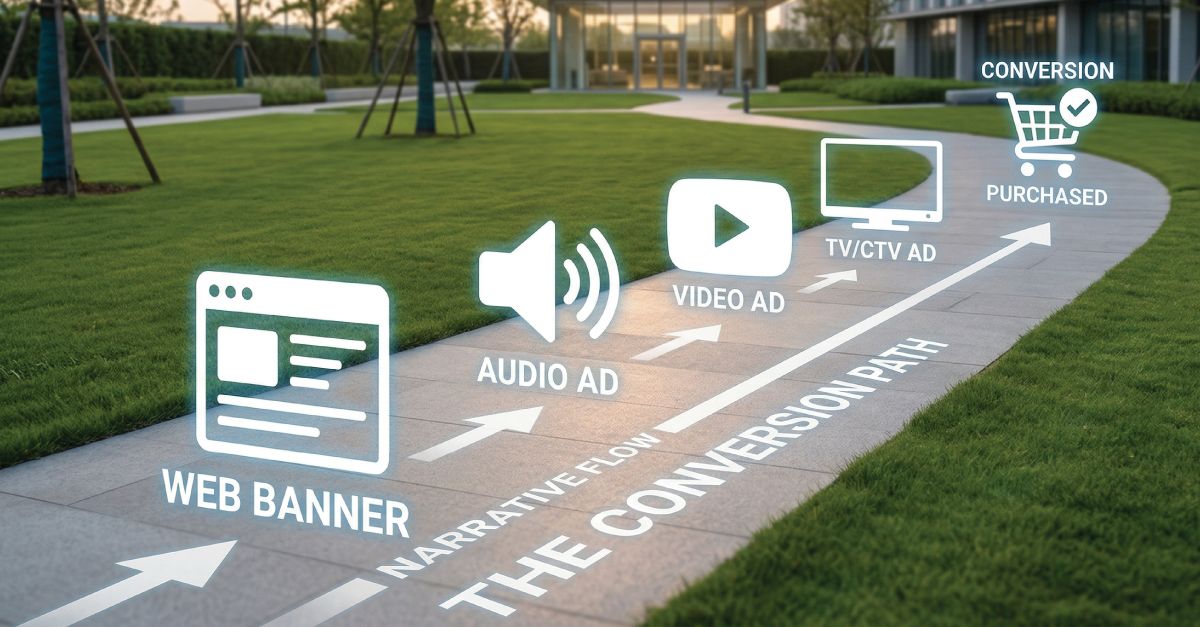
Knowing your channels is one thing. Knowing how to arrange them is where the real craft comes in. A well-structured sequence might look something like this:
- A display or native ad plants the seed, introducing your brand to someone who fits your target profile but has never encountered you before.
- Shortly after, an audio ad picks up the thread, adding context and personality in an environment where the listener is already engaged.
- Then a video ad deepens the emotional connection, showing rather than just telling
- Finally, a CTV spot brings it all home, reinforcing the full narrative in the most immersive environment available.
Each touchpoint builds on the last, never acting in isolation. This is what separates true omnichannel strategy from simply running ads on multiple platforms.


Chapter 6: Sharing the Story
Once your narrative is built, execution becomes everything. A few best practices can help ensure your campaign resonates with your audience:
- Maintain a consistent voice across channels. Consistency doesn’t mean repetition. Creative should evolve by format while staying true to the brand’s tone and message, helping avoid fatigue.
- Focus on meaningful metrics. Clicks matter, but engagement is what really leads to conversion. Time spent, completion rates, and frequency all help indicate whether your narrative is landing.
- Use data to track the journey. With Genius Monkey’s robust tools and reporting, advertisers can understand where each consumer is in the story. This insight informs pacing, retargeting, creative refreshes, or when to pause messaging altogether.
Chapter 7: Measuring Your Story’s Impact
A storyteller always seeks to improve their craft, and advertisers can use programmatic data to understand how the audience responds to the message. It’s tempting to lean on surface-level stats like impressions and click-through rates, but those only tell part of the story.
View-through rates tell you whether people are watching your video and CTV content to completion, which is a strong signal that the message is resonating. Audio completion rates serve a similar purpose. Time spent engaging with native and display content indicates genuine interest rather than an accidental tap.

Genius Monkey’s reporting tools are designed to surface exactly this kind of insight. Rather than drowning advertisers in raw data, the platform helps connect the dots between channels and touchpoints, so you can see the full arc of your campaign’s performance and make smarter decisions about where to invest next.
Epilogue: The Story Continues…
The best part of omnichannel storytelling is the ability to watch in real-time how well it is or isn’t working. Advertisers can make appropriate adjustments to suit the needs of the audience and learn lessons in preparation for the next campaign.
This process of continually optimizing, learning, and applying creates a virtuous cycle that helps your bottom line while growing trust with your audience. With an expert team on your side to answer questions and guide your focus, there’s no platform that does it quite as well as Genius Monkey.
If you’re ready to elevate your brand and message, it’s time to get in touch with Genius Monkey! Start increasing conversions and building a lasting relationship with your audience!