


 Create Account
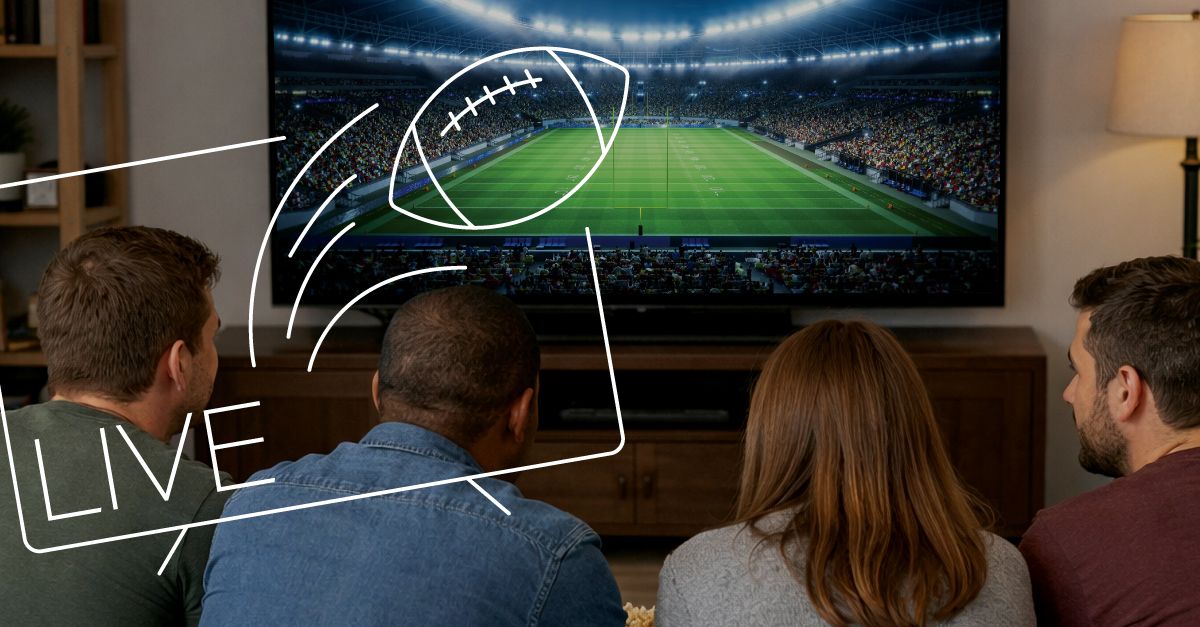
Last year, Super Bowl LIX drew an estimated 191.1 million unique viewers, setting a new record in 2025. Once again, the NFL championship game proved that it remains the single largest television event in the United States, and every Super Bowl season brings the same question back into focus for advertisers: Are people still watching sports on traditional TV?
The answer is yes – but not like they used to.
As we head into another Super Bowl season, it’s worth taking a closer look at how sports audiences actually consume content today, and what that means for advertisers deciding between linear and programmatic strategies. Let’s dive in:
Streaming vs. Linear Sports Advertising
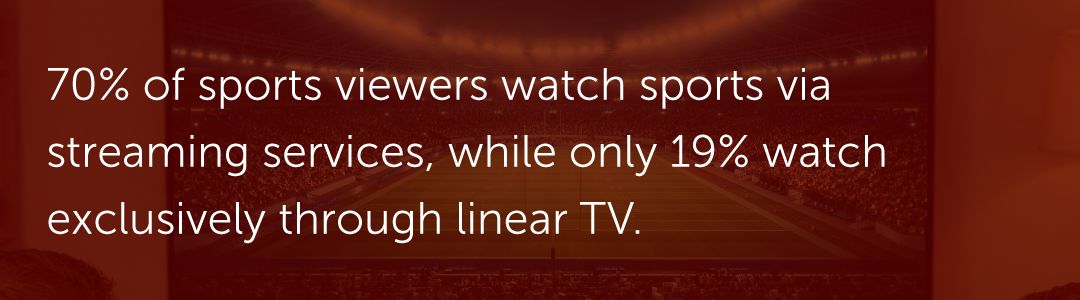
Over the last several years, sports audiences have steadily moved toward streaming. What was once a supplemental viewing option has now become the default for a majority of fans. Today, roughly 70% of U.S. sports viewers watch sports via streaming services at least part of the time. In contrast, only about 19% of viewers watch sports exclusively through linear TV. Genius Monkey has seen this shift in our own platform, noting a 340% increase in programmatic CTV buying for NFL playoffs, NBA, NHL, MLB, Golf, and other major sporting events.

That shift didn’t happen overnight, and it didn’t happen by accident. Streaming has grown because it aligns with how modern audiences live and consume media. Convenience is a major factor – fans want to watch games on their schedule, on their devices, and without being tied to a traditional cable package. Device flexibility matters too, as sports viewing now happens across smart TVs, tablets, laptops, and phones.
Perhaps most importantly, younger audiences are being introduced to sports through streaming-first experiences. For many younger fans, streaming isn’t an alternative to linear TV – it’s the starting point. Add in platform partnerships and exclusive broadcasts, and streaming has become embedded into the sports ecosystem itself.
Meanwhile, the audience for linear sports television isn’t growing. It isn’t attracting new viewers at scale, and advertisers who rely too heavily on linear sports advertising risk overexposure as audiences – and budgets – continue to migrate toward streaming. Linear campaigns often reach the same viewers repeatedly, while missing incremental audiences who no longer engage with traditional TV at all.
Streaming environments, on the other hand, offer far more flexibility. Advertisers can integrate sports messaging into broader marketing strategies, extend reach beyond a single channel, and align media spend with performance data. With all that said, football doesn’t follow the rules:
Linear TV Is Still a Major Player in Football
Football remains the last major stronghold for linear TV, especially when it comes to the Super Bowl. The NFL’s relationship with broadcast television runs deep, and for many fans, linear TV is still closely tied to how they experience football.
Many viewers maintain cable or satellite subscriptions specifically for NFL games. Die-hard fans often go even further, subscribing to multiple services to ensure they can watch every matchup. As a result, football has resisted the rapid streaming takeover seen in other sports.
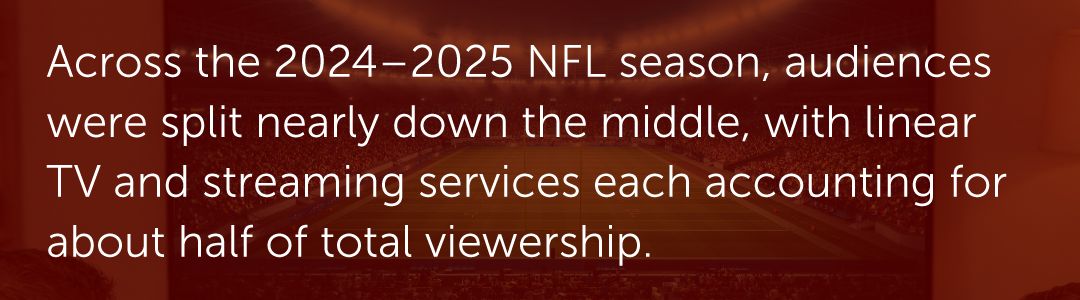
Across the 2024–2025 NFL season, audiences were split nearly down the middle, with linear TV and streaming services each accounting for about half of total viewership. Legacy viewing habits persist particularly among older demographics, and appointment viewing remains a powerful force for football.

That said, even football fans are making the shift. An increasing number of NFL games are broadcast exclusively through streaming platforms, and those games continue to post strong numbers. Most recently, the NFC playoff game on January 10, 2026 peaked at 31.6 million viewers, a clear signal that fans are willing to follow the league into streaming environments.
All signs point to streaming overtaking linear across 2026. Major leagues are pushing in that direction, streaming giants are investing heavily to secure exclusive rights, and the remaining holdouts for linear TV may soon find themselves paying more for less reach.
Linear TV will likely remain part of the NFL viewing mix for some time, but its days as the dominant method of consumption are coming to an end.
So, Is It Still Worth Advertising on Linear TV?
As with most marketing decisions, the answer depends on your audience.
Older generations and dedicated football fans remain the heaviest users of linear TV, and if those groups strongly overlap with your target audience, linear advertising can still play a role. For certain brands and objectives, linear placements can deliver scale and cultural relevance.
However, in most cases, a programmatic approach can reach a larger scale while offering significantly more control and insight. Programmatic campaigns leverage data and real-time optimization to place ads when and where they are most likely to perform – something linear simply cannot match.


Connected TV (CTV) ads in particular allow advertisers to reach incremental audiences that linear TV misses altogether. They enable smarter frequency management, audience layering, and performance tracking across devices. Instead of guessing who saw an ad, advertisers can observe outcomes, measure impact, and optimize accordingly.
Programmatic buying through Genius Monkey lets companies reach their audience through many paths. Advertisers can buy through the streaming services of all the major networks, including:
- YouTube TV
- Amazon Prime
- Sling TV Sports
- Disney/Hulu/ESPN
- Direct TV Live Sports
- Roku live Sports
- WBD
- Peacock
- Direct deals with CBS, Fox Sports, and NBC Sports
- And more…


The big takeaway is that linear TV isn’t completely obsolete, but it is no longer the most efficient way to reach sports-loving audiences on its own.
Going Pro with Programmatic
Because the Super Bowl is the biggest television event of the year, it’s easy to look at the numbers and think, “TV is back.” The reality is more nuanced: linear TV is already on the way out, and even its strongest advocates are investing heavily in streaming.
Some may feel nostalgic about the era of linear dominance, but advertisers now have access to something far more powerful: the performance, metrics, and connectivity of modern CTV and programmatic advertising.
Genius Monkey has been at the forefront of CTV advertising, harnessing its ability to capture attention while seamlessly integrating it into cross-device, programmatic campaigns. Our all-in-one platform has been shown to shorten the customer journey, reduce cost-per-conversion, and deliver industry-leading reporting and attribution.
If you’re looking to get into the CTV game for the Big Game, there’s no better time to start. Let’s evolve your marketing strategy to the next level and get in touch with Genius Monkey today!